When it comes to modern bass fishing rods, you might not know the name Rich Forhan—but you’re almost certainly fishing with some version of his ideas. Split grips. No foregrip. Spiral-wrapped guides. Trimmed-down reel seats. These now-common features were once radical departures from industry norms, and they all trace back to a relentless innovator who approached rod building with the mind of a scientist and the precision of a jet pilot.
Forhan’s legacy is more than just a list of innovations. It’s a comprehensive, performance-first philosophy that has redefined how serious anglers—and custom rod builders—think about their tools. This guide unpacks the essential components of high-performance bass fishing rods using insights drawn directly from the pioneering work and lifetime of experimentation by Rich Forhan.
The Origin of a Revolution
Rich Forhan grew up in rural Illinois, fishing bluegill with his father and building his first rods from Herter’s kits as a teenager. His love for the outdoors eventually collided with a distinguished career in the Air Force, where he flew C-141s, C-5s, and served as a weapons systems officer in the F-4 Phantom. That background in precision, efficiency, and engineering would later fuel his radical rethinking of rod design.
It wasn’t until he moved to Oroville, California, and met pro angler Gary Klein that the seeds of true innovation took root. Forhan introduced Klein to light-line crappie jigging techniques, while Klein returned the favor by immersing Forhan in the world of tournament bass fishing. That partnership led to the founding of Tournament Lures and eventually to two years of deep research culminating in Forhan’s first book, Powerhand Baitcasting, published in 1997.
Rods as Tools: Function Over Tradition
Forhan’s work always returned to a singular question: What does a rod need to perform its job—and what doesn’t it need?
That framework led him to strip rods down to their essentials, challenging decades of tradition. In his words, “It’s a blank, a handle, and some guides.” Everything else, from thread wraps to decorative components, needed to justify its place.
His core design principles reflect this ethos:
- Remove unnecessary material. If a part doesn’t add function, it doesn’t belong on the rod.
- Maximize sensitivity. Every decision must improve contact between the angler and the lure.
- Prioritize weight savings. A lighter rod isn’t just more comfortable—it’s more responsive.
- Build for technique. A rod must serve its specific purpose flawlessly.
Split Grip and No Foregrip: Game-Changing Ergonomics
Perhaps the most visible innovations Forhan popularized are the split grip and no foregrip handle configurations. While split grips had been used in surf rods, Forhan brought them into the world of bass fishing by asking one simple question: Why are we gripping something we never use?

By removing the foregrip, Forhan enabled direct contact with the blank. This dramatically improved sensitivity. He tested it on the water, fishing willow leaf spinnerbaits—a notoriously subtle bite—and immediately felt the difference. “I could feel a willow leaf turning through the water. I could feel a fish stop the blade,” he recalled.
Split grips provided two-handed casting capability while shedding unnecessary weight and material. Together, these handle innovations became foundational for tournament-grade rods and were quickly adopted across the industry.
Spiral Wrapping: Solving Stability at the Source
Another major development was the spiral wrap, also called the revolver wrap. It was a solution to a common baitcasting problem: rod roll. When under load, a baitcasting rod wants to twist toward the direction of the line. This creates instability and reduces sensitivity.
By guiding the line from the top of the rod to the bottom through a carefully placed set of angled guides, Forhan found he could stabilize the rod without compromising casting distance or control. “You can hold it with one finger,” he said, pointing out the enhanced balance and reduced fatigue during fights.
While he tried multiple spiral configurations, Forhan’s takeaway was pragmatic: they all work. “Just pick one,” he advised. “Anything that gets the line under the rod improves performance.”
Equal-Distance Guide Spacing: Simplicity That Works
Forhan challenged traditional guide spacing methods, which often relied on complex calculations or proprietary charts. His approach was refreshingly simple: equal-distance spacing.
By placing guides equidistant along the rod, Forhan found that he could maintain consistent load distribution and simplify the building process. It worked across rod types and techniques and became one of the central ideas of his guide philosophy.
For Forhan, the question was always, “Why make it harder than it needs to be?” His research proved you didn’t have to.
The Forhan Locking Wrap: Durability Without Compromise
Rod lockers are notorious for damaging guides, especially single-foot models. That’s why Forhan developed the Forhan Locking Wrap, a specific thread wrap method that alternates over the foot and the rod multiple times.
This wrap significantly increases durability, allowing single-foot guides to withstand heavy-duty use—even on rods designed for flipping and pitching into thick cover. The wrap also helped prevent epoxy cracking over time, contributing to the rod’s overall longevity.
“I wanted to be able to rip a rod out of a locker without damaging anything,” Forhan said. And now, thanks to this innovation, builders can offer single-foot performance with double-foot confidence.
RF Lite Reel Seats: Minimal Material, Maximum Performance
Another major step forward came in the form of trimmed reel seats. Traditional casting seats used excess material and often contributed to unnecessary weight and bulk.
Forhan asked: What’s the minimum amount of reel seat needed to secure the reel and transmit feel to the hand? The result was the RF Lite seat—a modified casting seat that used only what was essential for the job. By trimming and hollowing out portions of the seat, he created a direct line of contact with the blank while shaving off significant weight.
Drilled Trigger Hook Keepers and S-Bend Alternatives
Hook keepers have long been an annoyance for many anglers. They often corrode, break, or get in the way. Forhan’s solution, inspired by Gary Klein, was to drill a hole through the trigger of the reel seat, turning it into a discreet, corrosion-free hook keeper.
Later, he refined the idea further by designing the S-bend keeper—positioned between the split grip—to securely hold plastics and hooks without damaging lures or interfering with casting.
The Science Behind the Sensitivity
What sets Forhan apart from many innovators is how thoroughly he tested every hypothesis. He didn’t rely on gut feelings or anecdotal evidence when creating high-performance bass fishing rods. He used scales, stopwatches, high-speed photography, and field testing—often to the point of breaking rods on purpose.
One of his most surprising discoveries was that most of the pressure during a fish fight isn’t on the tip—it’s in the mid-section of the rod. “When the rod is under load, the tip points at the fish,” he explained. “There’s almost no side pressure on those top guides.”
This validated the use of single-foot guides and further reinforced the importance of proper loading techniques. Forhan’s data-driven mindset made his insights not just persuasive, but bulletproof.
High Modulus vs. Low Modulus: Choosing the Right Blank
While many anglers equate sensitivity with higher modulus graphite, Forhan was more nuanced. For jigs and finesse techniques, yes—high modulus blanks made sense. But for cranking and reaction baits, slower-action composites or fiberglass (especially S-glass) often delivered better performance.
In fact, he cautioned against using overly sensitive rods for flipping. “You might set the hook before the bass even closes its mouth,” he said. Sometimes, too much sensitivity is actually a disadvantage.
The Future of Innovation
So where do we go from here?
Forhan isn’t betting on dramatic leaps in rod design. In his view, most of the low-hanging fruit has already been picked. What remains is refinement—material advances like high-modulus fiberglass or better carbon-scrim hybrids, incremental guide improvements, and perhaps further ergonomic tuning.
He encourages modern builders to think like innovators, not decorators. “A rod is a tool,” he said. “If it’s not making you more efficient, more effective, or more connected to the fish, what’s it doing?”
Advice for Today’s Rod Builders
For anyone entering the craft or seeking to improve their builds, Forhan’s advice is clear:
- Start with the blank. All blanks have value. Learn how they behave and what each is suited for.
- Build with purpose. Every component should serve the rod’s function, not just its appearance.
- Test everything. Don’t take anyone’s word for it—not even his. Try it, compare it, and see what works.
- Don’t fear failure. Break a few rods. You’ll learn more from failures than from safe bets.
- Share what you learn. The craft advances when knowledge is passed down, not hoarded.
Rich Forhan’s Enduring Legacy
Today, whether you’re browsing bass fishing rods at a sporting goods store or building one in your shop, you’re seeing the fingerprints of Rich Forhan. His “revolver rod” concept—split grip, no foregrip, spiral wrapped, guide-optimized, function-first—is now the blueprint for performance rod design.
But his greatest contribution may not be any one feature. It’s a mindset. A challenge to question assumptions, prioritize function over form, and constantly ask, “Why?”
As Forhan says, “Build it the way you fish. Test it. If it works, it’ll stay. If it doesn’t, try something else.”
That’s the essence of high-performance rod building. And that’s the legacy of Rich Forhan.
Resources:
- Powerhand Baitcasting – Out of print, but treasured by collectors and serious builders.
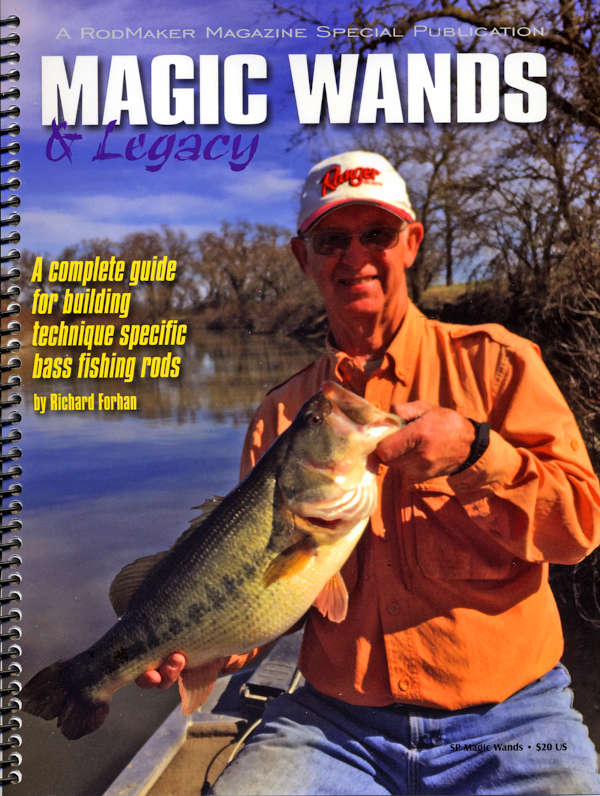
- Magic Wands and Legacy – Available via RodMaker Magazine, this is the most comprehensive guide to technique-specific rod building ever published.
- Maker Magazine Archives – A treasure trove of technical insight, experimental design, and contributions from Forhan and other leaders in the field.
Final Thoughts
High-performance bass fishing rods aren’t defined by the flashiest wraps or most expensive components. They’re defined by how well they disappear in your hands—how clearly they transmit a bite, how effortlessly they load, how balanced they feel during a day-long tournament grind.
Thanks to Rich Forhan, we now understand how to build those rods. And for those willing to keep asking “why,” there’s still room to push the craft further.
Just don’t forget to take your rod out and fish it. After all, that’s what it’s built for.