When you talk about innovation in travel fishing rods, few people have had a closer look at their evolution than legendary blank designer Todd Vivian. After decades at Lamiglas and nearly two decades designing MHX blanks for Mud Hole and Foundation Outdoor Group, Todd has seen it all—from nickel-plated brass ferrules to the seamless, high-modulus carbon connections we use today.
I sat down with Todd for a deep dive into the past, present, and future of multi-piece rod design, and why the modern travel rod is every bit as strong and sensitive as its one-piece counterparts.
From the Northwest to the Rod Bench
Vivian’s story starts in the Pacific Northwest, where fishing was simply part of life. “I grew up fishing with my grandfather on the Cowlitz River,” he said. “Steelhead, salmon, sea-run cutthroat—if it swam, we chased it.”
After serving as an electronic warfare technician in the Navy, Todd returned home, went to school for engineering, and spotted a classified ad that changed his life. “The day after I finished school, I saw an ad for Lamiglas looking for a pattern cutter. They hired me the next day. Within a few years, I was running production and managing both facilities.”
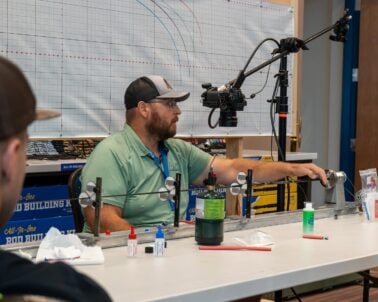
It was there that Vivian learned blank design from mentors like Al Jackson and a Boeing engineer who taught him the fine balance between science and feel. “You can’t design a blank purely by computer,” he explained. “You have to know how materials behave together—the tensile modulus, elongation, resin content. You only learn that through trial, error, and failure.”
The Evolution of Ferrules
For anyone who’s ever fished a multi-piece travel fishing rod, ferrule design is the heart of the story.
“The oldest ferrules were nickel-coated brass,” said Vivian. “They were strong, but heavy and created stiff spots in the blank. They worked for 30- or 40-pound rods, but not lighter graphite models.”
Next came spigot ferrules—internal plugs that required hand-fitting and a visible gap between sections. “People always thought something was wrong when they saw that gap,” Todd laughed. “But it has to be there. When the blank flexes, those sections meet. Without the gap, they’d crack.”
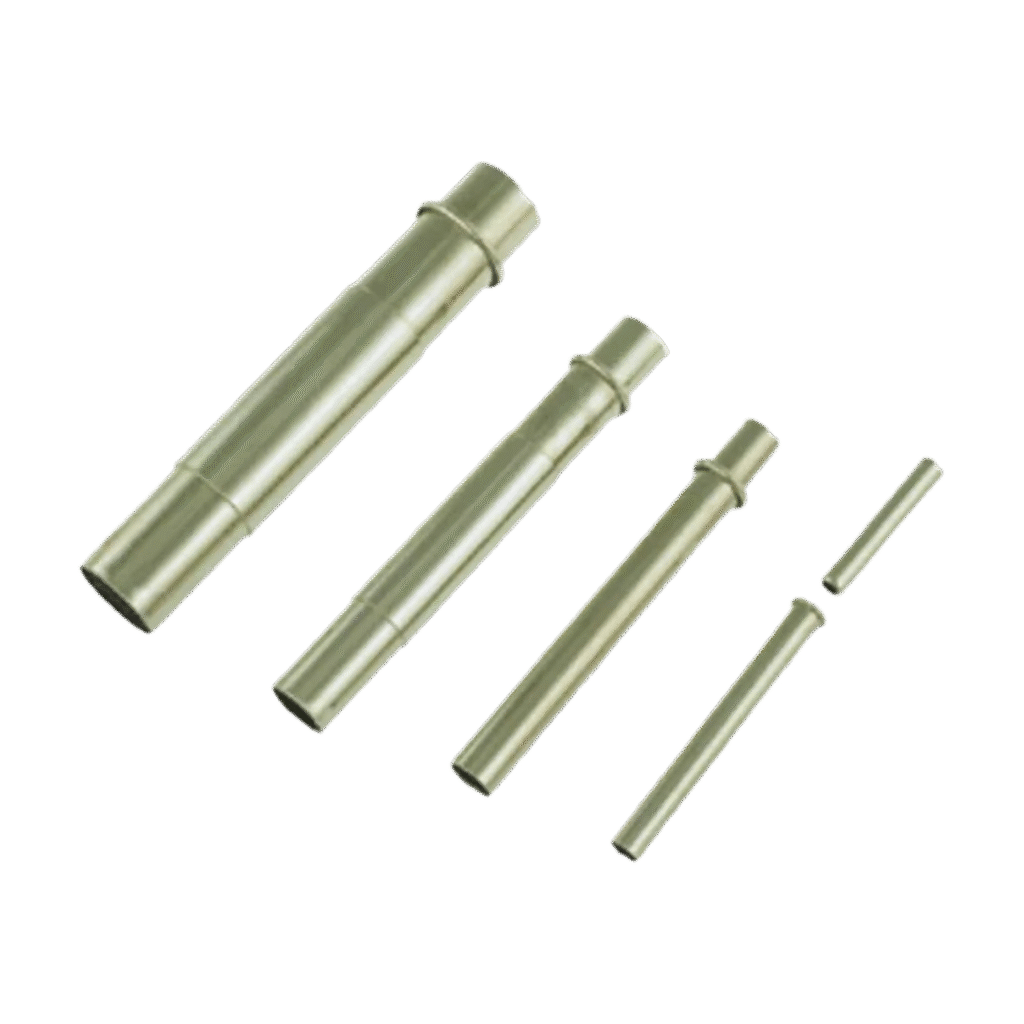
As carbon fiber and precision machining advanced, builders moved toward precision ground ferrules, and finally to tip-over-butt ferrules—now the modern standard.
“When you design a tip-over-butt rod, you’re not cutting up a one-piece blank,” Vivian said. “You’re designing multiple blanks from scratch—each on its own mandrel—so they flex seamlessly together. That’s why good tooling and consistent taper matching are everything.”
How Travel Rods Became Performance Rods
Early multi-piece travel fishing rods were convenient but rarely high-performing. Today, that’s no longer the case.
“With modern materials, you can get pretty much any rod you want—a three-piece, a four-piece—that’s every bit as durable and stable as a one-piece,” said Vivian. “I feel just as comfortable fishing a four-piece for redfish, trout, even tuna.”
Better resin systems, bias-cut reinforcement layers, and precision ground ferrule fits mean builders can now fine-tune strength and flex down to the millimeter. “We can even design multi-piece rods with taper changes unique to each section,” he explained. “You can actually create actions and powers that you couldn’t make in a one-piece rod.”
Heavy-Duty Applications: From Tuna to Surf
Modern travel fishing rods aren’t just for backpacking or fly anglers. They’re tackling offshore game.
Vivian has helped design three-piece, 50-pound-class tuna popping rods and surf rods with 70/30 or 80/20 splits, where the ferrule sits in the handle section for added strength. “Those allow you to build a larger-diameter tube with less material, which means it’s stronger and lighter,” he said.
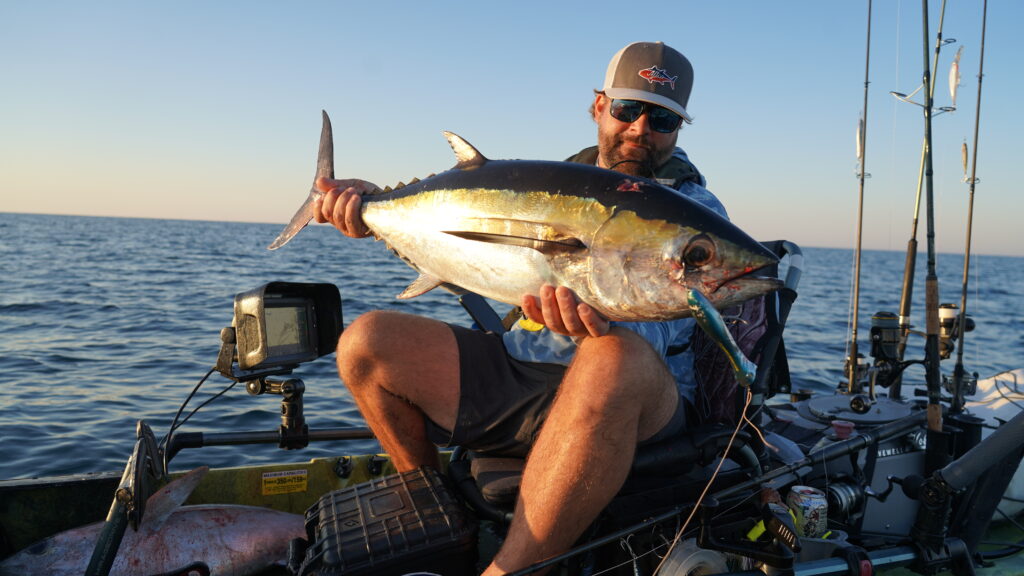
He even adapted the concept for musky and Great Lakes trolling rods, where telescoping handles help anglers fit long rods in tight boat lockers. “The stigma around two-piece or collapsible rods is gone,” Vivian said. “If it’s designed right, it’ll fish just like a one-piece.”
The Science Behind the Fit
One of the most overlooked parts of rod design is how precisely ferrules are made to fit.
“Twenty years ago, every section had to be hand-fitted,” Vivian recalled. “Resin content could change how far one piece seated into another by an inch or two. Today, manufacturing is so precise that replacement sections can be shipped out and fit perfectly.”
That precision has improved not only performance but also durability and warranty reliability.
Caring for Multi-Piece Rods
When it comes to maintenance on travel fishing rods, Todd’s advice is straightforward: keep ferrules clean.
“The worst thing you can do is wax them,” he said. “People used to use beeswax, but it holds grit. Drop that section in the sand, push it together, and you’ve just scratched the fit.”
Instead, Vivian recommends what he calls a bayonet lock when assembling. “You slide the section in at about a 90-degree angle, and as you start to feel friction, twist it about a quarter turn into place. That twist creates a little bite between the surfaces and keeps sections from loosening during use.”
Why Travel Rods Just Make Sense
Between airline length restrictions, shipping costs, and the sheer convenience of portability, travel fishing rods are no longer a compromise—they’re often the smarter choice.
“If I were younger,” Vivian admitted, “I’d probably only build multi-piece rods. There’s no reason not to. They’ll do everything a one-piece will do—and more.”
With the precision, consistency, and performance available today, modern builders can confidently put their name on a multi-piece travel rod knowing it will perform anywhere in the world.