Slow pitch jigging has become one of the most technique-focused styles of saltwater fishing, and at the center of it all is the blank. Blanks for true slow pitch rods must load deeply, recover quickly, and deliver power evenly without flat spots. To understand how that level of performance is engineered, I sat down with master blank designer Todd Vivian, who has spent more than 40 years shaping rods at Lamiglas, Mud Hole, Foundation Outdoor Group, and through countless OEM projects.
Todd has designed everything from fly blanks to offshore tuna sticks, but when the conversation shifted to slow pitch technology, he made it clear that the engineering behind these rods has evolved far beyond what most anglers realize.
Why Slow Pitch Rods Requires a Different Kind of Blank
Slow pitch jigging puts unique demands on a blank. Every lift, fall, and cadence begins with how the blank loads and rebounds. The rod must bend smoothly, recover cleanly, and then transition immediately into a deep, parabolic fight curve. That kind of control only exists because modern rod design has changed dramatically.
Todd explained that the performance gap between one piece and multi piece construction is largely gone. In fact, he said that “today you can get pretty much any rod that you want in a three piece or a four piece version that is just as durable, just as stable, and fishes just as well, if not better.” That evolution matters because slow pitch blanks rely on controlled movement, not brute power. The right multi piece design actually enhances that performance.
Inside the Mandrel: How Slow Pitch Rods Are Shaped
Unlike traditional tapers, slow pitch blanks often depend on multi taper mandrels that let designers build very specific transitions throughout the blank. Todd emphasized that this is one area where modern engineering gives builders more freedom than ever before. He told me that “you can create some really unique actions and powers in a three or a four piece rod along with the taper changes that are in each section,” and followed it by saying that “you can design actions that you cannot build in a one piece rod.”
That is the secret behind slow pitch performance. Each section can be tuned separately to influence the load, the recoil, and the fighting bend. Instead of forcing everything into one long continuous taper, designers can sculpt the behavior of the blank in distinct zones. For a technique built on precise rod movement, that level of control is game changing.
Ferrules That Disappear Into the Action
For years, anglers viewed ferrules as weak points. In early generation multi piece rods, they were. They added weight, created hinge points, and disrupted the blank’s bend curve. But modern ferrule design is a completely different world.
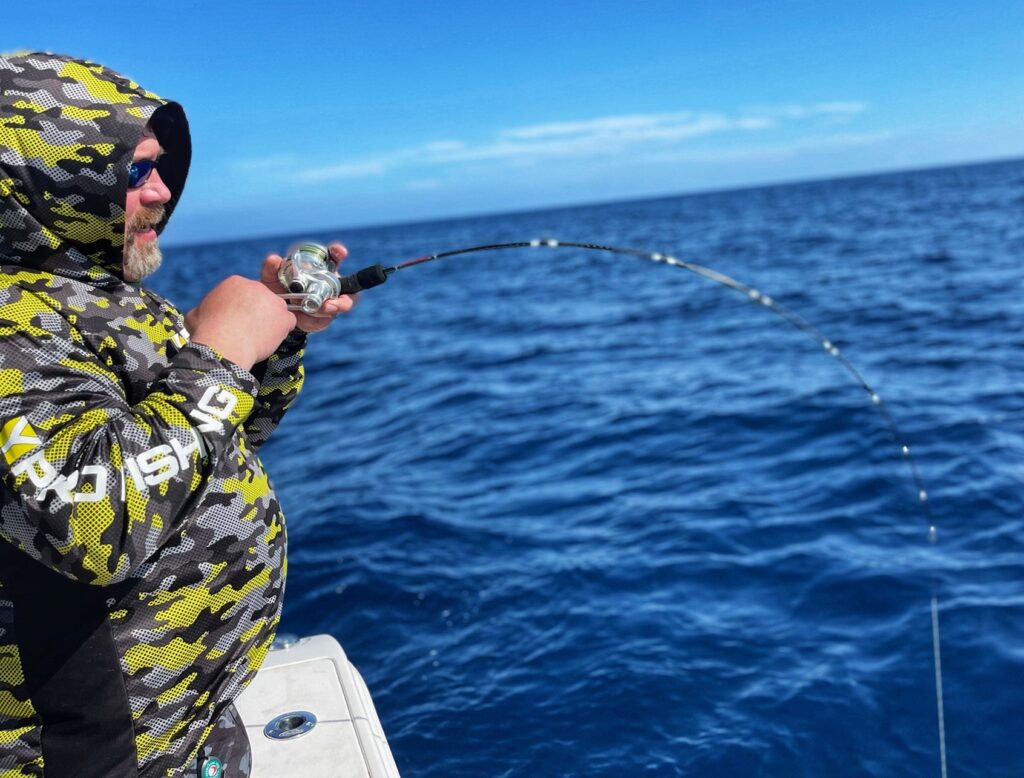
Todd pointed out that the tolerances are now so precise that “you cannot even tell where the joints are.” He has watched anglers fish rods he built and only later tell them they were multi piece. That seamless transition is crucial for slow pitch because any interruption in the curve can kill the jig’s natural fall and rhythm.
He also made it clear that modern ferrules are no longer a liability when a big fish is on the line. He said, “I feel as comfortable fishing a three or four piece rod for redfish, for trout, even up to tuna.” If a blank designer is fighting tuna on multi piece rods, slow pitch builders can trust the engineering.
Slow Pitch Rods Strength and Durability
Slow pitch anglers routinely target powerful, deepwater species such as amberjack, grouper, snapper, and tuna. These fish put enormous vertical loads on a rod, especially when using compact high drag reels. Modern blanks are built to withstand that pressure.
Todd shared a story that illustrates how far things have come. “I had an 80 pound model brought to me because I wanted something heavier, but I wanted a travel rod,” he said. He wanted a rod that could survive 80 pound class drag and still pack down small. The fact that he pursued a multi piece version says everything about how reliable current ferrule and taper systems have become.
Strength is no longer the question. The only question is how to balance that strength with the slow pitch action anglers expect. Today’s materials and designs allow both.
Why Slow Pitch Rods Are Better Than Ever
The engineering behind slow pitch rods is the result of decades of improvement in mandrels, resins, materials, and design philosophy. Multi taper mandrels allow designers to shape the exact load profile. Modern ferrules allow multi piece rods to bend continuously. And precision manufacturing creates repeatable performance section after section.
Todd offered what may be the best summary of this evolution. He said, “There is no reason you would not use a multi piece rod. The slow pitch blanks today are just as strong and they fish just as well. The game has changed.”
And that is the truth behind all great slow pitch rods. The engineering has caught up with the technique. What anglers feel on the water is the result of design decisions made deep inside the blank long before the rod is ever wrapped or built.