Air Carbon Mesh for rod building is easy to misunderstand if you only see it in a short video.
At a glance, it may look like a simple strip of black carbon material being used to hold guides on a rod blank. But according to Aleks Maslov of North Fork Composites and Edge Rods, the material is really the result of decades of rod blank development, composite experimentation, and a long-running effort to make fishing rods lighter, stronger, and more efficient.
To have Air Carbon Mesh explained, Maslov said you have to start with the basic design philosophy behind Gary Loomis’ work.
“Weight is a deterrent to performance,” Maslov said.
That idea has shaped much of the work at North Fork Composites and Edge Rods. In rod design, weight is not just a number on a scale. Extra weight can make a rod feel slower, duller, less responsive, and less sensitive in the hand. For a company built around high-performance blanks, removing unnecessary weight without giving up strength has always been the goal.
That is where Air Carbon Mesh comes in. It is not just a cosmetic material, and it is not simply a shortcut for wrapping guides. At its core, Air Carbon Mesh is a long-fiber carbon material designed to add strength, improve efficiency, and allow resin to move through the material properly. Maslov described it as part of the company’s larger effort to build rods that are light, durable, and responsive without relying on unnecessary materials that can reduce performance.
Why Rod Blanks Need More Than Straight Carbon Fiber
A fishing rod blank may look like a simple tapered tube, but it has to handle a lot of complicated forces. When a rod bends, the blank does not just flex in one clean direction. The tube wants to oval, twist, compress, and recover. If the wall of the blank buckles under load, the rod can fail.
“The problem that you have with a lot of carbon fiber is typically hoop strength,” Maslov said. “You can get it to be really, really tough. But visualize here, we’ve got a tube, and when you bend it, you get it to oval. And typically what happens is when it breaks, it’s because you’ve got the side of that tube that has buckled.”
That is one of the main problems rod manufacturers are trying to solve. A blank needs longitudinal strength, meaning strength running along the length of the rod. But it also needs hoop strength, meaning strength around the tube. Hoop strength helps the blank resist ovaling and buckling when the rod is under load.
“Everything that we do in tube manufacturing is to prevent that tube from buckling as you put it under load,” Maslov said.
For decades, one of the ways manufacturers handled that problem was by using scrims.
What Is A Scrim?
In rod blank construction, a scrim is a supporting material used to help hold carbon fibers together and improve the structure of the blank. Maslov explained that traditional carbon fiber blanks often include fibers running in one primary direction, while scrims help keep those fibers in place and support the tube structure.
“Historically, everything that you’ve seen in the carbon fiber manufacturing era, people have used what we call scrims,” Maslov said. “Typically what that does is that helps to keep that fiber together.”
The issue is that many traditional scrims are made of fiberglass. Fiberglass can add durability and structure, but it also adds weight. And in a high-performance carbon blank, every added material has to justify itself.
“When people talk about, ‘Hey, I want to have the lightest, most sensitive rod,’ you start to take away sensitivity the more glass you start to put in there as a scrim,” Maslov said.
That does not mean fiberglass is bad. Fiberglass has its place, especially in rods where durability, forgiveness, and a slower action are desired. But in a high-modulus carbon rod designed for light weight and sensitivity, replacing fiberglass scrim with carbon-based support can be a major step.
That pursuit helped lead to earlier carbon scrim technologies.
The Roots Of Air Carbon Mesh
Maslov described Air Carbon Mesh for rod building as a descendant of older carbon scrim work, especially what he called paper carbon scrim.
“When Gary was at G. Loomis, they discovered something called paper carbon scrim, and that’s been around for some time,” Maslov said. “That was the background, the basis of IMX and GLX.”
Paper carbon scrim was important because it helped create a rod blank system that was closer to being fully carbon. Instead of relying on fiberglass scrim, manufacturers could use carbon-based material to support the blank structure. But paper carbon scrim had limits.
“Paper carbon scrim, by itself, is a chopped fiber,” Maslov said. “It’s a veil. It’s about a quarter of an inch long. It’s random. It goes in random orientations.”
That chopped, random structure was useful, but it was not the same as having long fibers oriented in a controlled direction. Short chopped fibers can help create a thin carbon veil, but they do not provide the same targeted structural advantage as longer fibers that can wrap around the blank.
Air Carbon Mesh builds on that older idea by using longer carbon fibers that can be oriented more precisely.
“As we kept experimenting and refining what paper carbon scrim was 30 years ago, we discovered that you can orient fiber strands in a specific direction, and you can make them long enough to where you can get several wraps around the blank to provide that hoop strength,” Maslov said. “So that’s the basis of Air Carbon Mesh.”
That is one of the key ideas behind the material. Air Carbon Mesh is not just carbon fiber dust, chopped fiber, or a random veil. It uses longer fiber strands that can be laid in a controlled orientation to help support the rod blank.
Why Fiber Length And Direction Matter
A big part of Air Carbon Mesh’s performance comes from fiber length and fiber direction. Maslov explained that earlier carbon scrim materials were limited by short, randomly oriented fibers. Over time, the technology improved to the point where manufacturers could spread extremely light carbon fibers into a more uniform sheet and control the direction of those fibers.
“So it took a couple of decades to get to a point where you can have a manufacturer that can uniformly spread something that is lighter than a Kleenex in a sheet form,” Maslov said.
That kind of uniformity matters. If the material clumps in one area and leaves gaps in another, it will not perform consistently. A rod blank is a thin, highly stressed structure. Small inconsistencies can matter.
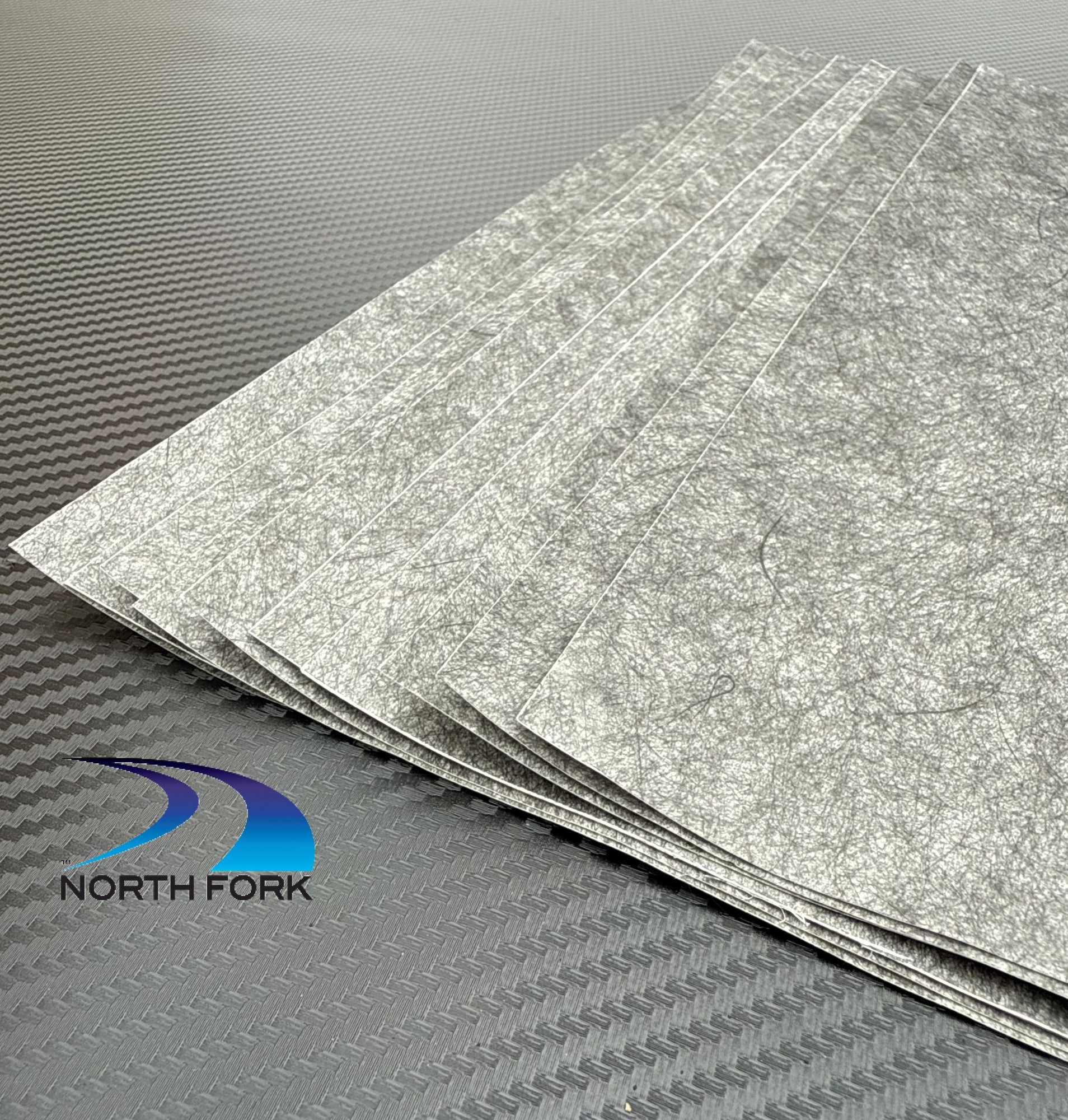
Maslov said the manufacturing challenge was not just making a light carbon sheet. It was making one that could be controlled.
“You can tell them, hey, this is eight grams per yard, 12 grams per yard,” he said. “And then you start to vary the length, two inches, three inches, five inches. Now we can make it .98% in a specific direction.”
That ability to control weight, fiber length, and orientation is central to what makes Air Carbon Mesh different from older carbon scrim systems. It allows the material to be used in a more deliberate way, rather than simply adding random carbon reinforcement.
In simple terms, the longer and more controlled the fibers are, the better the material can be used to solve a specific problem. In this case, that problem is helping a rod blank resist buckling, hold shape under load, and do it without adding unnecessary weight.
Why Resin Permeation Is So Important
One of the most important parts of Air Carbon Mesh is also one of the least obvious. The material has to allow resin to move through it.
In composite construction, carbon fiber is not working alone. Resin is what binds the fibers together and allows the finished part to behave like a unified structure. If resin cannot move through a layer properly, that layer can become more like a barrier than a working part of the blank.
Maslov used a simple image to explain the problem.
“This Air Carbon material is an inner layer in all of our Air Carbon blanks, and you have to have resin permeation in that layer,” he said. “Because if you don’t, essentially it’s like you’re putting a straight jacket on a blank and stuff doesn’t transfer through.”
That is why Air Carbon Mesh had to solve more than one problem at the same time. It was not enough for the material to be light. It was not enough for it to be strong. It also had to work with the resin system.
Maslov said the key was finding the right adhesive web, one that could hold the carbon material in place while still allowing resin to pass through it.
“The breakthrough really came where we found an adhesive web that allows all sorts of resin to permeate through the carbon fiber,” he said.
Without that, the material would not work the same way. Maslov explained that even if the carbon fiber itself has open areas, the wrong adhesive can block resin flow.
“It doesn’t matter how permeable you can make something,” he said. “As soon as you put sticky stuff on the back of it that doesn’t allow any resin to transfer, that stops the entire process right there.”
That detail is a major part of the Air Carbon Mesh story. The performance is not just in the carbon fiber. It is in the combination of long fiber, low weight, controlled orientation, proper adhesive, and resin movement.
Why It Took So Long To Develop
Air Carbon Mesh may sound simple once it is explained, but Maslov said the required pieces did not all exist in the right form decades ago.
Long carbon fibers had to become available in the right format. The material had to be light enough for a fishing rod, strong enough to matter structurally, and uniform enough to use in production. The adhesive system had to allow resin to pass through. And the overall system had to survive real use, not just look promising in the shop.
Maslov said Gary Loomis had experimented with earlier versions of carbon scrim and carbon guide-wrapping ideas decades earlier, but the material and adhesive technology were not ready.
“Thirty years ago is the first time that Gary tried to wrap any sort of guides to a blank with something that is called paper carbon scrim,” Maslov said. “It doesn’t have the strength to it. It doesn’t have the long fiber that can wrap around the guide.”
The problem was not a lack of imagination. The problem was that the supporting technologies had not caught up.
“There’s three things that had to happen,” Maslov said. “Something that can be long enough to wrap a guide foot around the blank, something that is both strong enough and light enough, and then at the same time, you have to have a sticky adhesive that can allow other material to pass through it.”
Maslov said those requirements came together as the broader composites industry advanced. He mentioned other industries, including wind turbine repair, as examples of places where composite materials and adhesives continued to improve. Fishing rods are a niche application, but they benefit from larger advances in carbon fiber and resin technology.
“The composites industry kept marching over the last 30 years,” Maslov said.
That larger march is part of why Air Carbon Mesh for rod building exists now instead of 30 years ago. The idea was not entirely new. The ability to execute it at the right weight, strength, and consistency was.
Air Carbon Mesh Inside The Blank
For many anglers and builders, the most visible use of Air Carbon Mesh is as a guide wrap. But Maslov explained that the material is also used inside Air Carbon blanks as part of the blank structure itself.
That distinction matters because Air Carbon Mesh should not be understood only as an external wrap material. Its first role is structural. It helps the blank achieve the performance target North Fork Composites and Edge Rods are after: light weight, hoop strength, durability, and responsiveness.
Maslov said the material used in the blanks has unusual properties. It has “plenty of elongation,” meaning it can stretch or move under load without immediately failing, while still being a high-modulus material. High-modulus carbon is often prized for light weight and sensitivity, but it can also be more brittle if not used carefully. Maslov said Air Carbon blanks are notable because they stay relatively durable for their weight.
“What makes Air Carbon different, the blanks, is for the weight that they are, they’re fairly durable,” Maslov said. “You can whack it on the side of a boat and not worry that it’s going to microfracture like a lot of other high-mod blanks.”
That does not mean the rods are indestructible. Maslov was careful not to oversell the point. A high-performance blank can still be damaged by abuse. But his point was that the Air Carbon system is designed to give anglers the lightness and feel they want without making the blank overly fragile.
“You can’t take that and be abusive with it,” he said. “But it will handle a lot.”
Air Carbon Mesh And Guide Wraps
The guide-wrap use of Air Carbon Mesh came partly from other experiments inside the company. Maslov said the team had been working with linen materials and trying to attach guides with strips of linen prepreg. Linen is a hollow, permeable fiber, and those experiments helped them think differently about guide attachment.
“We started wrapping our linen blanks and trying to match the wraps of linen with linen prepreg, because linen is permeable,” Maslov said. “It’s a hollow fiber.”
That work helped lead to a realization. If they were thinking about permeable fiber wraps with linen, why not revisit the idea with carbon fiber, especially now that they had longer carbon strands, a permeable mesh structure, and the right adhesive system?
“What we have not done in a long while is try to wrap guides again with actual carbon fiber strands,” Maslov said. “Now they’re longer. They’re permeable. The mesh is there.”
That led to what Maslov described as a eureka moment inside the shop.
“You don’t really realize what you have until you wrap it,” he said. “You discover that not only is it strong, not only is it permeable, but you can’t really rip a guide off with your hands, and the blank starts breaking before the guide rips off.”
From there, Air Carbon Mesh became more than an internal blank material. It also became a way to attach guides with a light, clean, carbon-based wrap.
The Role Of The Activator
One of the more technical parts of using Air Carbon Mesh is activation. Maslov explained that when mesh overlaps on itself, the open spaces in the material can begin to close up, much like wrapping gauze around your finger. The more layers overlap, the more the openings can get blocked.
“If you think of a cheesecloth, even if you wrap a cheesecloth like a gauze on your finger, eventually you close up the holes,” Maslov said.
That matters because resin still needs to move through the material. To solve that, the team leaned on chemistry. Maslov credited Larry Hopper, a longtime chemist who has worked with Gary Loomis, for helping identify the right type of compound to open the pores and allow resin flow.
“We approached it with a technical challenge and said, listen, we’ve got a problem,” Maslov said. “When you align these holes one on top of the other, they close up the pores.”
The solution involved compounds that could activate the binder and help open the material back up. Maslov said rod builders may already know this type of product as color preserver, or CP, but he emphasized that it is not being used in the same way it is used on thread.
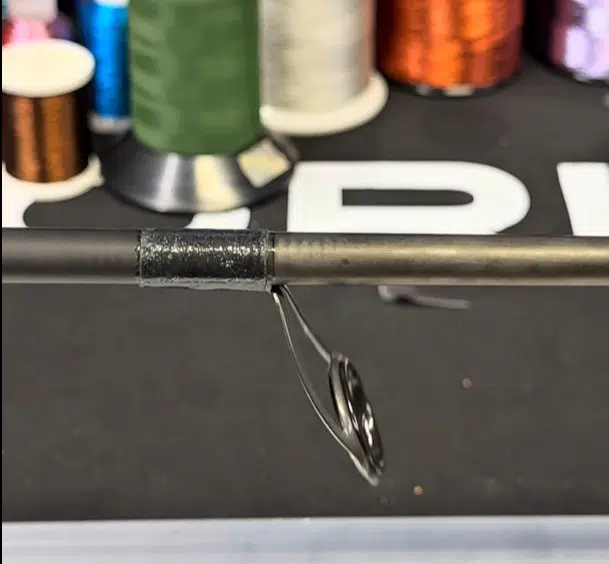
“The compound that you guys call color preserver has it,” Maslov said. “You just need a tiny amount of it, and as soon as you put a little bit of it on, it’ll dissolve all those holes that are overlapped, and it allowed that resin to flow through.”
That detail can get confusing because CP has a long history in thread wrapping, where it is mainly associated with preserving thread color before finish. With Air Carbon Mesh, Maslov said the point is different. It acts as part of the activation process.
“A chemical reaction happens when those ethers touch the binder in there,” he said.
Why Cutting Direction Matters
Air Carbon Mesh is not equally strong in every direction. That is because the fibers are oriented. The direction of the cut determines how much fiber strength ends up in the strip being used.
Maslov said the difference is dramatic.
“The effect is staggering,” he said. “It’s like a 5x strength one direction versus the other.”
That is why the company emphasizes cutting the material the right way. If a builder cuts it in the weaker direction, the strip will not behave the way it should. If it is cut in the stronger direction, the fibers can do their job.
Maslov said a simple pull test makes the difference clear. If a builder is unsure which direction is correct, he can cut a small strip and pull on it by hand. One direction will break much more easily. The correct direction will be noticeably stronger.
“If you’re not sure about which direction of the sheet is, just cut yourself a quarter-inch strip, maybe about two inches, three inches long, and just pull on it,” Maslov said. “You’ll be able to tell right away.”
That is a small detail, but it shows why Air Carbon Mesh is more technical than it first appears. The material is simple to use once understood, but the builder still has to respect the way the fibers are designed to work.
How It Is Applied To Guides
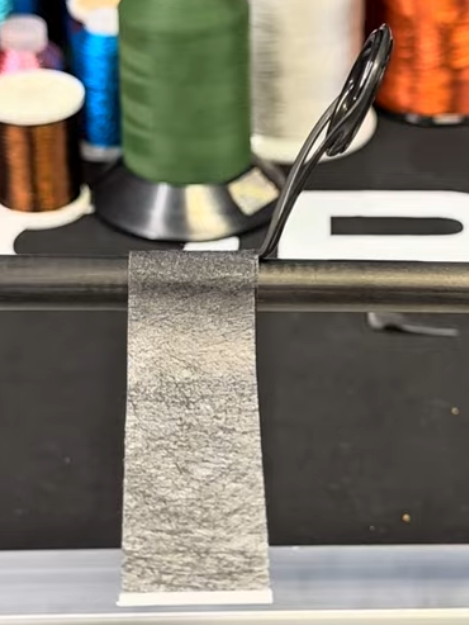
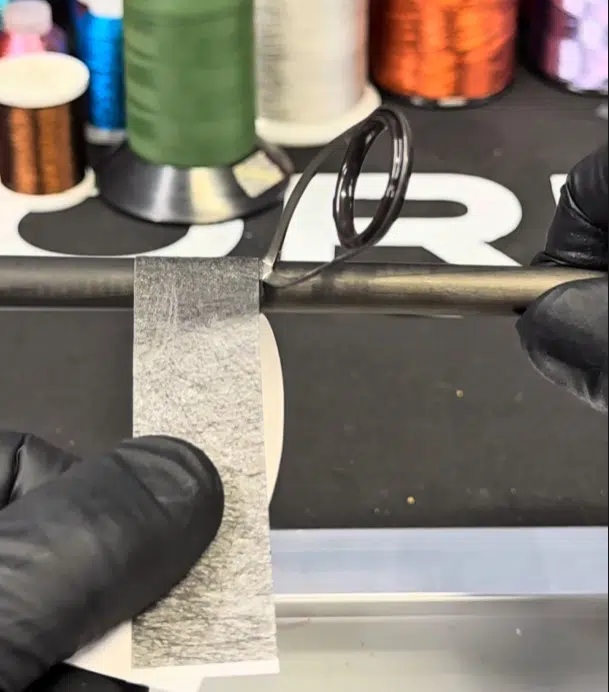
When using Air Carbon Mesh to attach guides, Maslov said the basic idea is to cut a strip slightly longer than the guide foot and wrap the guide with enough overlap to secure it properly.
“We say about a sixteenth longer than your guide foot,” he said. “That creates a very nice taper to where it doesn’t look bulky.”
For heavier guides or the first guide on a rod, he said they typically recommend more wraps. For running guides, fewer wraps may be enough.
“We typically say start with three on your very first guide,” Maslov said. “Especially if you’re doing like an acid wrap, and it’s got a 45-degree offset, and then as you go to the running guides go to two wraps.”
The goal is not to build up a bulky wrap. The goal is to cover the guide foot with enough material to create a clean, strong attachment while keeping the finished profile low.
“As long as you go over your guide foot twice with the Air Carbon Mesh and the running guides, three times on the first stripping guide, that’s perfect,” Maslov said.
He also recommended paying attention to the direction the rod is turning when finish or activator is applied. The brush should push the edge of the mesh down rather than lifting it.
“You’re going to be agitating those fibers with a brush tip, and you want to keep them down,” Maslov said.
Again, this is not complicated once it is understood, but it shows that Air Carbon Mesh has its own technique. It is not just a strip of material placed on a blank. It is a fiber system, an adhesive system, an activator system, and a finish system working together.
What Not To Do With Air Carbon Mesh
Because Air Carbon Mesh behaves differently from thread, some common thread-wrapping habits do not carry over. One of Maslov’s clearest warnings was about thinning the first coat of finish.
“The only thing that we tell folks to do that are used to doing it with thread is don’t thin your first coat with acetone or denatured alcohol,” he said. “Because that will fuse the binder.”
That is the opposite of what the builder wants. The material needs the pores to open so finish can move through. Solvents like acetone or denatured alcohol can close things off and make the material behave more like a solid sheet.
“If you use denatured alcohol or acetone, you can try it on a sheet,” Maslov said. “That’ll just make it like a sheet of ice, fully solid, fully close it.”
After the material has been activated and the first coat has done its job, later finish steps may be more forgiving. But the first coat matters because that is where the system needs to bond and permeate correctly.
That point may be especially useful for experienced builders. The more experience someone has with thread, the more likely they may be to bring old habits to a new material. Maslov’s message is that Air Carbon Mesh should be treated as its own system.
Air Carbon Mesh And The Future Of Rod Design
Air Carbon Mesh is already being used inside blanks and as a guide-wrap material, but Maslov said the company is also looking at new ways to use it visually and structurally. One of those future directions involves colored Air Carbon Mesh on the outside of blanks.
That is notable because Gary Loomis has long resisted adding paint or unnecessary finish to blanks. The reason goes back to the same philosophy that started the conversation: weight is a deterrent to performance. Paint adds weight. Even small amounts of added material matter when the goal is to make a blank as light and responsive as possible.
Maslov said the new color work is different because the color is built into the structure rather than applied as a traditional paint layer.
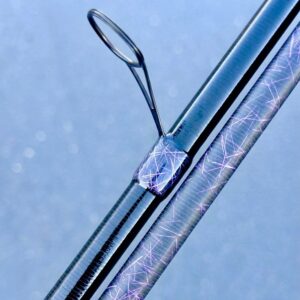
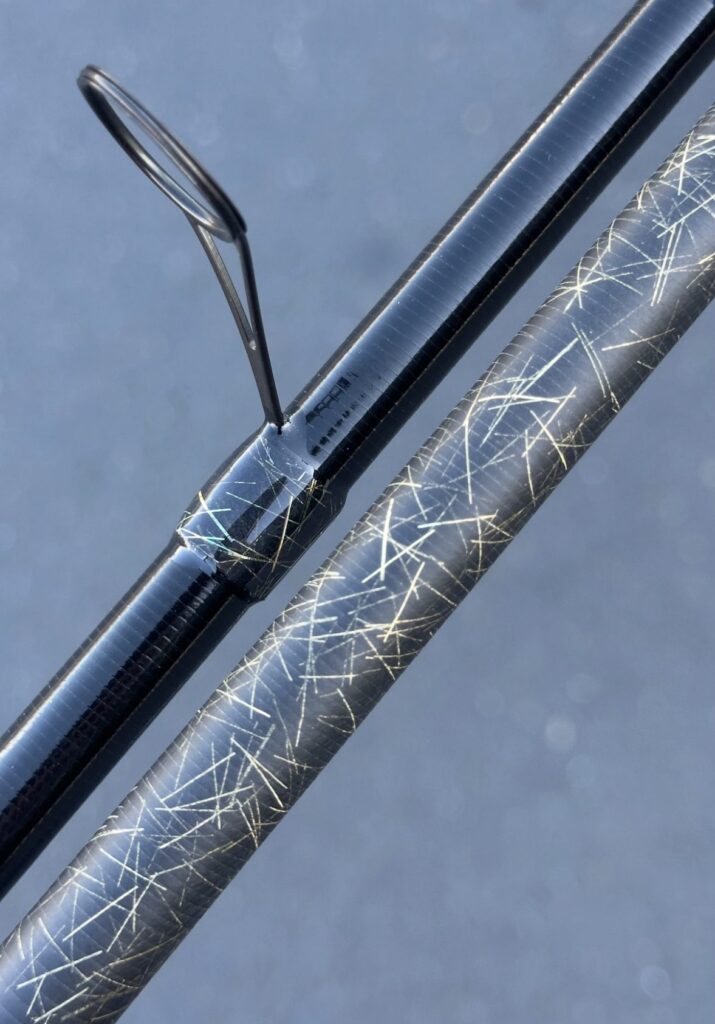
“We’re going to start putting Air Carbon Mesh on the outside of blanks,” he said. “So you’ll see the violets, reds, golds, silvers, where it’s part of the overall structure.”
He described blanks where the carbon is still visible, but colored accents are baked into the resin system.
“You can still see the carbon through it, but you see accents of silver, of red, of whatever those colors are baked into the resin of the blank,” Maslov said. “It’s not going to be a paint.”
That is an important distinction. The color is not just decoration added after the fact. It is part of the material approach. For a company that thinks carefully about weight, that is the only reason the idea fits the design philosophy.
“Since it’s part of the resin, it doesn’t add weight,” Maslov said. “I’m okay with a color accent.”
A Material Built Around A Simple Idea
The more Maslov explained Air Carbon Mesh, the clearer it becomes that the material is not built around one single feature. It is not just light. It is not just strong. It is not just carbon. It is a combination of things that have to work together.
The fibers have to be long enough. They have to be oriented correctly. The sheet has to be uniform. The adhesive has to hold the material without blocking resin. The resin has to permeate. The activator has to open the pores. The finish has to be applied correctly. When used in a blank, the material has to support the tube under load. When used on a guide, it has to secure the guide foot without adding unnecessary bulk.
That is why Air Carbon Mesh is best understood as a composite system, not just a product.
It grew out of older carbon scrim technology, especially the paper carbon scrim work that helped shape famous G. Loomis blank families like IMX and GLX. It reflects Gary Loomis’ long-standing belief that unnecessary weight hurts performance. And it depends on newer material and adhesive technologies that were not available in the right form decades ago.
For anglers, the result is a rod blank system meant to be light, crisp, strong for its weight, and more durable than many people expect from high-modulus carbon. For rod builders, the visible result may be a clean carbon guide wrap. But behind that simple-looking strip is a long chain of material science, manufacturing lessons, and trial-and-error problem solving.
Maslov summed up the larger story best when talking about why the concept took so long to become reality.
“The composites industry kept marching over the last 30 years,” he said.
Air Carbon Mesh is part of that march. It is an old idea made possible by newer materials. It is a way to add hoop strength without falling back on heavier scrims. It is a way to move resin through a carbon structure instead of blocking it. And in the hands of North Fork Composites and Edge Rods, it is another expression of a simple design rule that has guided Gary Loomis for decades.
Weight is a deterrent to performance. Air Carbon Mesh is one more attempt to remove that deterrent without giving up the strength a fishing rod needs.