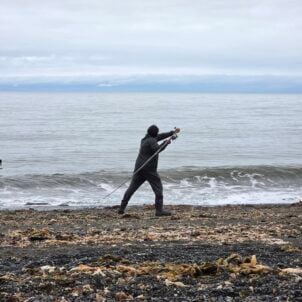
Whether you’re custom-building your own gear or picking something off a retail shelf, the first step in choosing a fishing rod is always understanding its primary purpose. Think about a standard bass rod: it’s engineered to be accurate, to manipulate a lure effectively, and to drive a hook home with authority. Or consider a surf rod, which has one clear objective, launching a heavy sinker far beyond the breaking waves. A traditional European carp fishing rod, by contrast, has a significantly different, more specialized mission.
According to custom rod builder Mark Crouse, that mission is one that many American anglers simply misunderstand. “Where Americans go wrong when they try to replicate the English and European carp rods is that they are not built to fight the fish,” Crouse said. “They are built to get the distance in the cast.”
This distance-first philosophy dictates every design choice. Traditional carp rods are exceptionally long, deeply flexing, and outfitted with surprisingly few guides to minimize friction. Their handles are extended to provide the leverage needed for a powerful two-handed cast, while the blanks are designed to load through a broad, almost circular curve. Ultimately, the result is a highly specialized tool for bank-fishing, crafted to deliver bait to skittish carp that might be sitting hundreds of yards from the shore.
Why European Carp Rods Are Built for Distance
European carp fishing evolved in a culture where bank fishing is the norm, rather than fishing from boats. Boats are much less common on European waterways, and access is frequently restricted on many major rivers and tributaries, making the bank the angler’s only option. “Boat fishing in Europe is very minor compared to here,” Crouse said. “Boats are insanely expensive, and most tributaries do not allow boats.”
Because of this, European carp anglers have to find ways to reach fish that an American angler would simply approach by boat. “Fishing from the bank means that, if you want to get the big carp, you need an insane distance,” Crouse said. This becomes even more critical because the largest, most trophy-worthy carp are notoriously cautious. “Big carp are shy,” he said. “The bigger they get, it seems the shyer they get. My dad always said, ‘That’s why he got big, because he stayed away from the bank.’”
Whether these fish are naturally wary or have learned to avoid shoreline activity, distance quickly becomes the angler’s greatest advantage. “Everything is pointed toward going after the really big carp,” Crouse said. “You don’t worry too much about the fighting power. You’re worrying about getting to the fish.”
Choosing the Best Carp Fishing Rod Blank
Building a quality carp fishing rod starts with selecting a blank designed to store and release a massive amount of energy during the cast. A builder shouldn’t just grab the stiffest blank on the rack or apply the design standards used for an American bass, inshore, or general-purpose spinning rod. Instead, you need a blank that is long, progressive, and deeply flexing.
Action
While American rods usually fall into clear-cut categories like fast, moderate, or slow, traditional European carp blanks are categorized differently, by a “pounds” system. This pound measurement is known as the test curve, which tells the builder how much load is required to bend the blank to a specific point, providing a rough idea of the rig weight the rod can handle.

“A true carp fishing rod is totally parabolic to get that insane distance,” he said. Rather than just flexing in the upper tip, the blank loads deeply through nearly its entire length. This broad bend stores energy during the casting stroke and releases it efficiently as the rod straightens. Once a fish is hooked, this deep action also acts as a shock absorber for sudden, violent runs. It’s a stark contrast to using a short, stiff rod to try and force a fish toward you. The carp rod absorbs the load, letting the reel’s drag do the heavy lifting.
Butt
The butt section needs to be an active part of the cast, not just a rigid handle. Crouse explains that some specialized distance blanks are tapered in both directions, allowing the section beneath the angler’s lower hand to contribute to the loading process. “If you have a rod that is tapered on both ends, you’ve got a true catapult in your hand,” he said. “It is literally going to make a circle when you cast. The kinetic energy is going to shoot up in that rod like crazy, and you will get an insane distance.” While the lower section must handle the stress of a heavy casting load and the initial run of a large fish, the goal isn’t to create an immovable object. It should load progressively alongside the rest of the rod.
Test Curve and Casting Weight
Carp anglers select their rods based on their test-curve rating rather than conventional lure-weight labels. “They’re distinguished by the load weight: a 1-pound rod, 1½-pound, 2½-pound, 3-pound or 4-pound rod,” Crouse said. As a general rule of thumb, he suggests using about 30 grams of casting weight for every pound of test curve.
“For every pound, you can roughly estimate 30 grams of casting weight, so a little bit over an ounce,” he said. “If you have a 4-pound rod, that’s 120 grams of casting weight.” A 3-pound rod typically handles around 90 grams, or just over 3 ounces. Crouse notes that a 3-pound test curve is a common middle ground for most situations. “Four and a half is the highest standard,” he said. “The average is three.”
Remember that total casting weight includes the sinker, hook, rig, bait, and any other terminal tackle. Use these conversions as a baseline, but always defer to the blank manufacturer’s specific recommendations.
Power
Standard power terms like “medium-heavy” or “heavy” don’t really capture the nuance of a traditional carp fishing rod. Again, you’re better off looking at the test curve, length, and loading pattern. Don’t fall into the trap of thinking a more powerful rod gives you more control over a big fish.
“If you get a big mirror carp of 70 or 80 pounds, you need 200 or 300 yards of line left on your reel because he will make a long run,” Crouse said. “Even if you have a rod with better fighting power, it is still not going to stop him.” In fact, trying to muscle the fish can backfire.
“The stiffer your rod is, the more chance he is going to rip his lips,” Crouse said. The system…rod, reel, and drag…must work as a unit. The rod absorbs the initial strike, while the drag allows the fish to run without overloading the blank or tearing the hook loose.
Tip
The tip needs to assist in loading the rod while retaining enough strength to cast a heavy rig. It should recover smoothly, but it doesn’t need the lightning-fast, crisp response of an American bass rod. Sensitivity isn’t really the goal, either. “Ninety-nine percent of carp fishermen use a hair rig because, among other things, it helps the fish to hook himself,” Crouse said.

With a hair rig, the bait sits just off the hook. When a carp tries to spit it out, the hook pulls toward the fish’s mouth. As the fish swims away, it eventually pulls against the sinker. “They usually give him about two feet of lead that he can run before he has to drag that sinker,” Crouse said. “Now he gets speed for two feet. When that sinker hits, the hook is really in him.”
Because the rig and sinker do the heavy lifting, the angler doesn’t need to feel for subtle bites through the blank. Most of the time, the rod is sitting on a pod with an electronic bite alarm, and the hook-set happens long before the angler touches the rod.
Length and Number of Pieces
Traditional carp rods are usually 12 or 13 feet long, according to Crouse. That length is crucial for creating a broad casting arc and gaining the leverage needed to hit extreme distances. It also helps manage the fish during long runs. Since a 13-foot rod is cumbersome to transport, it’s almost always built in multiple sections. Before doing any handle or guide work, you need to assemble the entire blank to check for proper ferrule fit, ensuring the rod maintains a smooth, progressive curve under load.
Weight
A 13-foot rod is never going to feel as light as a short spinning rod, but weight management is still vital. Every guide, wrap, and layer of finish affects the blank’s ability to load and recover, particularly near the tip. The best way to save weight? Buy premium components. “If you buy the best blank and the best components you can afford, you will have the best product,” he said.
The labor involved in installing a cheap guide is identical to installing a high-quality one. “If a guide costs $20 or a guide costs $10, it is still the same work to put it on the rod,” Crouse said. “If you are building for yourself, buy the best material you can afford.” That is the reality of custom building: “The American consumer thinks, ‘If I build my rods myself, I will save money,’” he said. “You are not saving money. You are making the better item.”
Picking the Best Carp Fishing Rod Handle Type and Material
While a typical spinning rod handle usually stops near the elbow to keep it from feeling awkward, a carp fishing rod handle needs to be long enough to facilitate a massive casting stroke. “You put one hand on the butt,” Crouse said. “You put the other hand up on the reel seat with the reel foot between your fingers, and then you see what movement you can make to get full extension out of your arms.” Before fixing the reel seat in place, simulate the casting motion to ensure you can reach full extension. “If I cannot extend the arm that is holding the reel all the way, I know I have to bring the reel seat a little farther down,” he said. “That is how you determine where you are going to set your reel seat.”
You only need grip material where your hands actually make contact, so there’s no reason to cover the entire space between the butt and reel seat. The rear grip may use cork, EVA or another durable material, but it does not need to cover the entire area between the butt and the reel seat. The angler only needs grip material at the points where the hands contact the rod.
Fore Grip
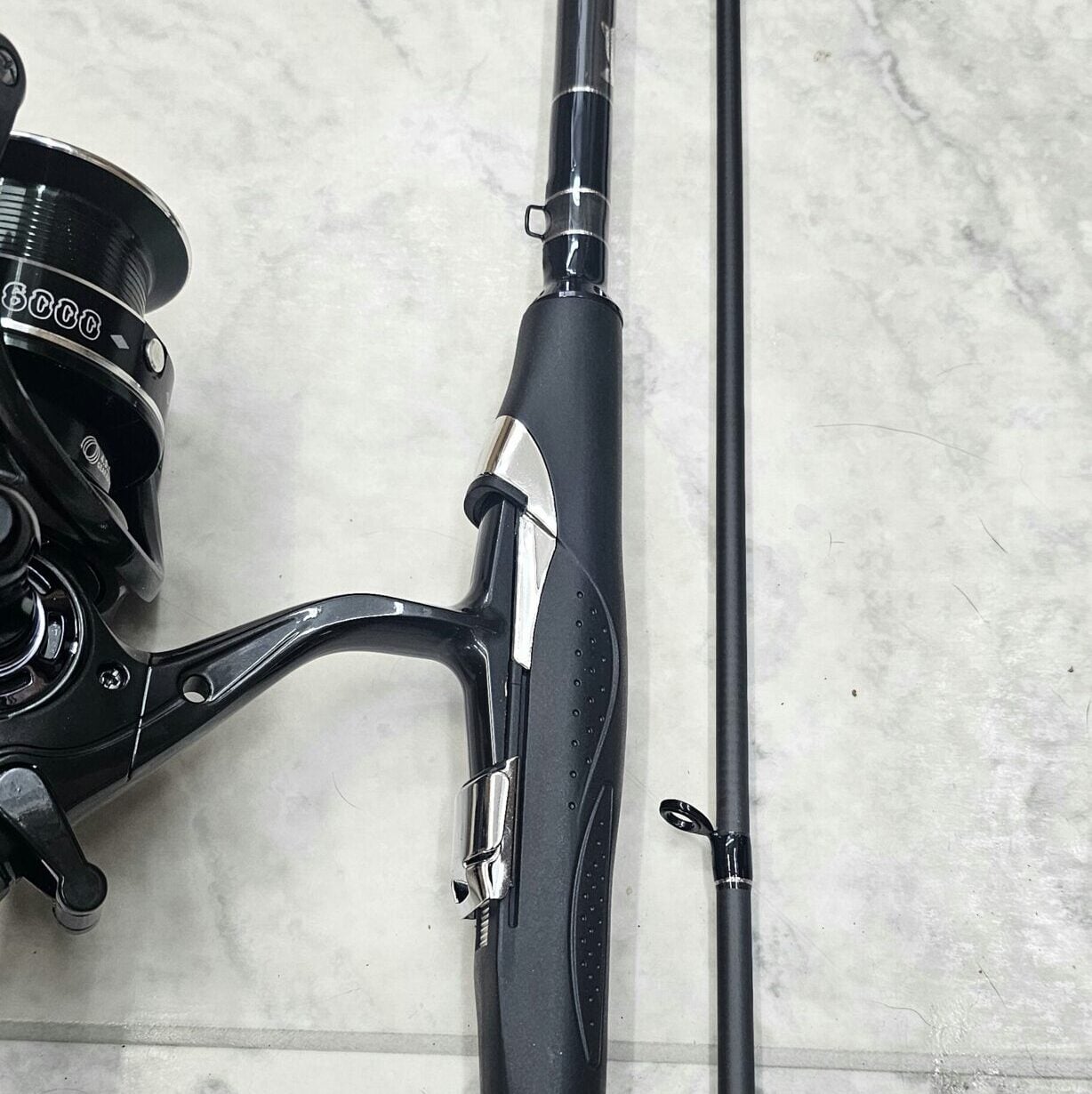
True to the minimalist philosophy, these rods usually lack a conventional fore grip entirely. “They have no handles there,” Crouse said. “They only have a butt handle where you are gripping it and the reel seat. That is all of a handle they have on carp rods.”
This keeps the weight down and allows the blank to flex more freely. Leaving the section between the butt grip and the reel seat exposed is standard, and Crouse prefers split-grip builds for this very reason. “I use split grips because the rod can work better and the rod can bend better,” he said. “Cork is expensive, and you don’t need all that cork. You are never going to put your hand on it.”
Reel Seat
“The most traditional reel seat is the Fuji NPS,” Mark said. It offers a clean, understated aesthetic that fits the European style perfectly and can be finished with simple winding checks. “The NPS shows off better, and it looks good,” Crouse said. Always make sure the seat fits your specific reel, and establish its position early. Because the reel determines the line path, setting the reel seat location is a critical, non-negotiable step. “You are going to first set your reel seat where it has to be,” Crouse said. “That has to be written in stone because you have to stay comfortable.”
Butt and Cap
Keep the butt assembly secure, durable, and compact. It takes a lot of abuse during the casting stroke and when resting in rod pods. By keeping it short and secure, you allow more of the blank to load during the cast.
The finished butt assembly should remain relatively compact. Traditional rods rely on leverage from the distance between the butt and reel seat rather than on a long section of continuous grip material. A short, secure butt grip also allows the blank beneath it to contribute more freely to the casting load.
Winding Checks and Decorative Wraps
“What they do behind and in front of the reel seat is use something like a winding check that recesses into the reel seat,” Crouse said. Most people don’t decorate them,” he said. “They keep them as clean as possible.” If you do add a wrap, make it functional. Historically, surf rod builders added thread wraps near the handle to reinforce the leverage point where the angler’s hand pivots.
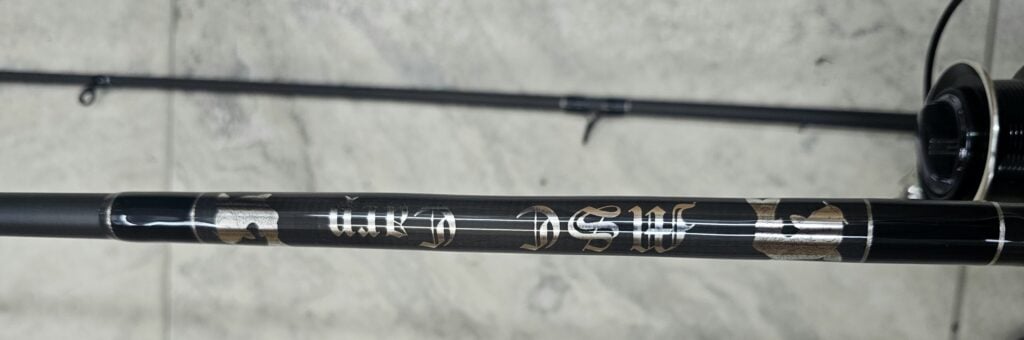
“We started decorative wraps on surf rods many moons ago,” he said. “The reason is that it gives the rod more strength at the leverage point.” You are essentially building an extra shell to handle the stress. “You are wrapping thread right above your hand,” Crouse said. “That gives the rod more strength because you are building another shell.”
That does not mean every carp rod needs elaborate decorative work. A simple reinforcement wrap may accomplish the purpose while preserving the traditional appearance.
Selecting the Best Carp Fishing Rod Guide Train
This is where the “distance-first” mindset is most apparent. “We call it the English lazy version,” Crouse said. “Lazy because a 13-foot rod will only have five guides. It restricts the line less, and you get a great casting distance.” When built right, these setups perform incredibly well. “If you buy, as an example, the Trebuchet from Harrison and build it with that setup, they will guarantee a 200-meter cast,” he said. “That is about 225 yards, so that is an insane distance.”
Crouse once tested this by handing a rod to an average angler on the beach, who managed a 200-yard cast on his first try. However, there is a trade-off. “If the rod is under a lot of power from a big fish, rod breakage is very common,” Crouse said. With fewer guides, the load is concentrated, and the line forms sharper angles as the rod bends. You have a choice: stick to the traditional, minimalist layout for maximum distance and accept the risk, or use more guides to distribute the load more safely.
“If you use a 13-foot rod, use at least 10 guides because then you can distribute the power better,” Crouse said. A builder can reproduce the traditional low-guide-count layout and accept the increased risk in exchange for maximum distance. The other option is to use more guides and spread the load more evenly.
Many American anglers prefer the second option. That modified layout may be better suited to those who do not need a 200-yard cast and want a more durable, versatile rod. “I tell everybody to tweak it,” Crouse said. “You want that distance, and you can get that distance with a few more guides, but you have to be very careful how you set them.”
Deciding on the Best Carp Fishing Rod Guide Set
You need lightweight, smooth guides, but placement is everything. Crouse is adamant about not using generic spacing charts. Always bend the specific blank you are working on to set your guides manually. “When they describe a blank, they might say 39- to 41-million modulus,” he said. “They are already saying 39 to 41. They do not know exactly what each number will be.”
For that reason, Crouse sets the guides according to the bend of each individual blank. “I never use a recipe for a rod,” he said. “I bend every single rod I build and set the guides.”
Positioning the Stripper Guide
To do this properly, load the blank deep to see where the curve begins in the lower section.“I take the rod at the tip and bend it down really far,” Crouse said. “Probably a little farther than most fish will bend it.”
Place your first stripper guide right at the start of that deep curve. If you put it too far forward, you’ll end up with an excessively steep angle that creates friction and can ruin your line. The goal is always to keep line contact as minimal as possible.
“The line is supposed to touch a guide as little as possible,” he said. Crouse pointed to Fuji Torzite guides as an example of guide geometry designed to manage line efficiently while the rod is under load. “The inside ring is not round,” he said. “It is flat because, when the rod is at an angle, the line barely touches.”
Determining the Best Carp Fishing Rod Thread and Epoxy
Keep the threadwork simple and understated. Dark or natural colors are the standard for these rods, which spend a lot of time sitting on the bank. “They keep them very, very simple,” Crouse said. Use clean, compact, and properly tensioned wraps. Over-wrapping the tip will just add weight and kill the rod’s performance. As with the handles, if you use a wrap for reinforcement, make sure it has a structural purpose, not just a cosmetic one. “You do thread wraps around a blank and put finish on it, and you build another shell,” Crouse said. The wrap should never be used to hide damage or compensate for an unsuitable blank. Its purpose is to reinforce a known leverage point and provide a finished appearance.
Your finish needs to be flexible enough to handle deep, parabolic bends without cracking. Apply it in thin, uniform coats rather than heavy globs. Precision in mixing and curing is essential; a great finish can be ruined by poor technique. Again, don’t skimp on quality here—the work involved is the same, so use a finish that you can trust.
Should American Builders Copy the Traditional English Carp Rod?
Crouse respects traditional English design, but he doesn’t think you need to copy it slavishly for American waters. “I tell everybody to tweak it,” he said. If you’re fishing a smaller local reservoir, you probably don’t need a 200-yard cast. You’d be better off with a rod that trades some of that extreme distance for better durability and fish-fighting control. Use the same foundation (the 13-foot parabolic blank and the two-handed handle) but adapt the guides and test curve to fit your actual needs.
Ultimately, remember that the “traditional” way isn’t “better”; it’s just specialized for a specific goal. “Everybody has their own style,” Crouse said. “Your style would not work for me, and my style would not work for you.” That is ultimately the greatest advantage of building a custom carp fishing rod. The builder is not merely copying a factory design. The reel-seat location, handle length, guide layout and finished action can all be adjusted around one angler and one style of fishing.
Carp Fishing Rod Building Kit
To build a traditional-style carp fishing rod, start with a 12- or 13-foot, multi-piece spinning blank with a progressive, parabolic action. A 3-pound test curve is a solid starting point for general use, while a 4-pound blank is better for heavier rigs and long-distance casting. Your handle should be at least 25 inches long, but customize it to your own arm length. Pair it with a short butt grip, a quality butt cap, and an NPS-style reel seat. Guide count depends on your priorities—a traditional “lazy” build uses about five, while a more durable, load-distributing build should use 10 or more.
Whatever you choose, don’t rely on charts. Set your reel seat, load the blank, and place your guides based on the actual bend. Finish with quality thread and flexible epoxy.
As Crouse reminds us, the goal is quality.“If you are building for yourself, buy the best material you can afford,” he said. “You will have the best product.” If you aren’t ready to build one yourself, check the Angler’s Resource Custom Rod Builders Directory for a pro.