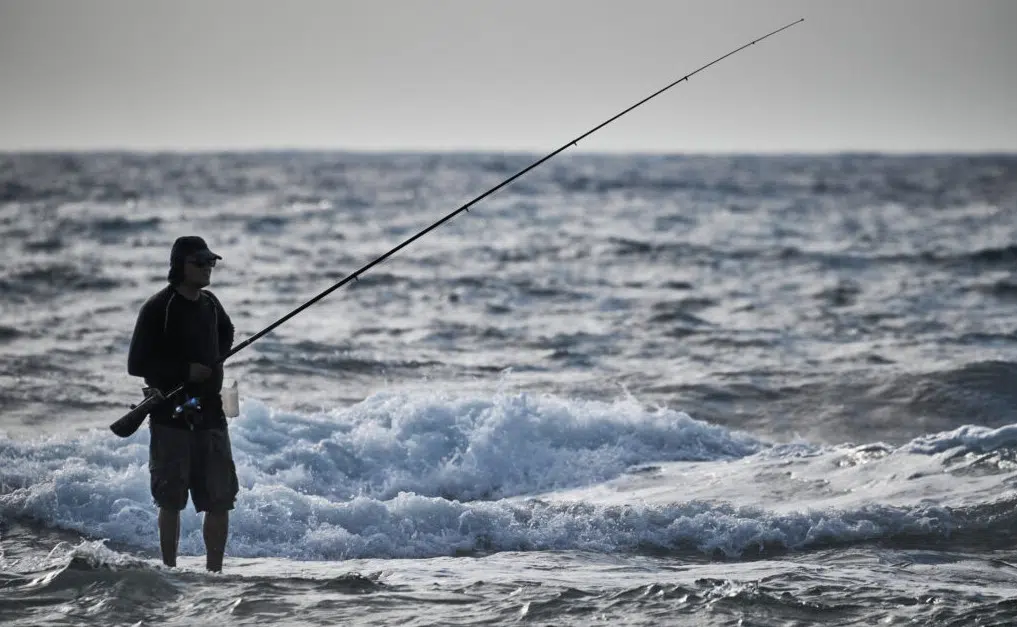
Tommy Farmer, a world champion level distance caster and lifelong surf angler from North Carolina, built his reputation on one thing: putting baits where other people cannot. As he tells it, the obsession started on an early morning at Cape Point.
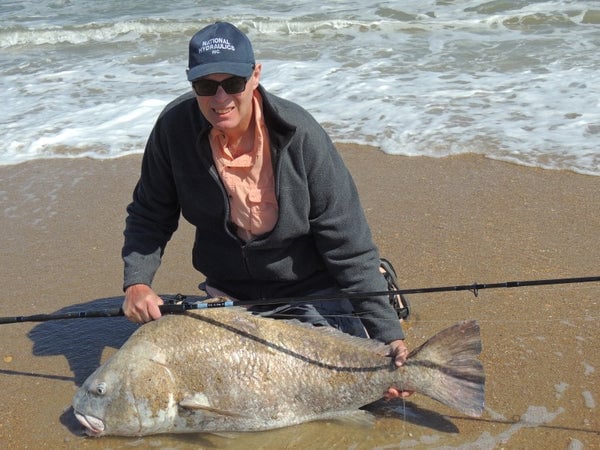
“I threw my first cast from Cape Point, caught, fought and landed a 45 inch drum,” Tommy said. “It was a life altering morning.”
Then he watched a caster step in beside the line and launch a cast that changed everything.
“I had never seen anything like it,” he said. “This guy bombed a cast out there, way past everybody else, hundreds of feet past me.”
From that point forward, Tommy chased technique, not shortcuts. “I was 39 years old when I started,” he said. “I had to learn the techniques. I could not get by on athleticism or sheer size and strength.”
That mindset is exactly what surf anglers and custom builders need when they want a surf casting rod that can consistently throw weight and bait a long way, control a running drum in current, and survive a hard season on sand and rocks.
Competition Distance vs Real Fishing Distance
Distance casting tournaments and drum fishing share DNA, but they are not the same animal. Tournament casts are made with aerodynamic sinkers, controlled line diameter rules, and no bait. Fishing adds the messy stuff: chunk bait, wind in your face, abrasive structure, and a fish that wants to leave the zip code.
Tommy’s longest measured practice cast was nearly 900 feet. “My longest cast ever was in practice, 897 feet measured,” he said. “My longest casting competition was 859.52 feet.”
On the beach with bait, the numbers come back to earth, but they are still serious.
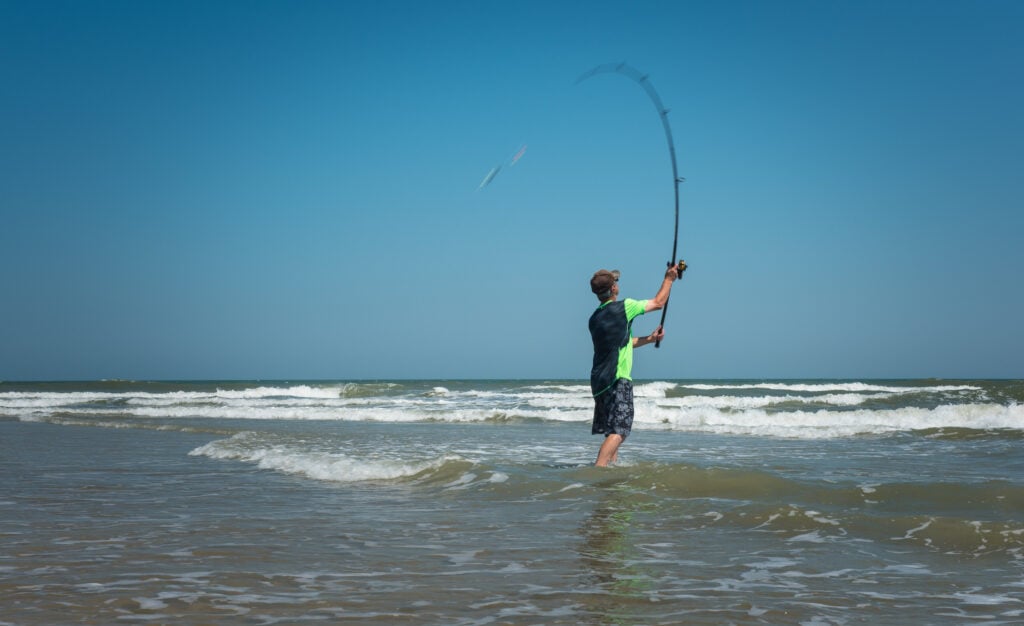
“An average cast for me on the beach is going to be between four and 500 feet with bait,” he said.
That is the point of a purpose-built surf casting system. The rod, the reel, the line, the leader, the knot, and the rig all have to work together.
The Reel Question: Why Revolving Spool Still Wins on Distance
If you care about maximum distance, the reel matters. Tommy is blunt about it.
“The best casters in the world can’t come close to the same distance with a spinning reel as they can with a multiplier or overhead,” he said.
That does not mean a spinning reel is wrong. It means that if you want the farthest legal casts with control, a non-levelwind revolving spool reel is the tool.
Tommy fishes reels from Akios, a UK manufacturer known for surf multipliers.
“I fish with a reel, the company’s called Akios,” he said. “They make a fine quality reel all the way across the board.”
He also makes a key distinction between a tuned tournament reel and a fishing reel.
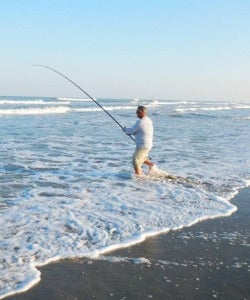
“This reel would be useless for fishing,” he said about a high-performance tournament setup. “It’s too fast. It would blow up every cast.”
For fishing, control is king. “My fishing reels I like on the slow side,” Tommy said. “If I took one of my fishing reels and spun it like that, it might spin 10 to 12 seconds.”
The message for surf anglers is simple: do not chase a free-spool party trick. Chase a reel that you can keep on the edge of control, even when you are tired, cold, or shoulder-to-shoulder with other anglers.
Line and Leader: Mono, Shock Leader, and Real-World Abrasion
Surf casting rods that throw weight and bait hard need a shock leader. Not a bite leader. A shock leader.
“Use a shock leader,” Tommy said. “I don’t mean a bite leader, a shock leader.”
His drum setup commonly starts with 20 to 25 pound monofilament, then steps up to a heavy leader for casting safety and abrasion resistance.
“We usually use 50 to 60 pound test,” he said, and he is very specific about wraps on the spool. “With a minimum of eight wraps only turns around the spool.”
If you are tempted to cut that number, he has seen what happens. “Three is not enough,” Tommy said. “If you have the slightest bit of thumb slip, you’re going to get that zing, that crack off that three turns.”
Tommy’s preference for mono over braid on surf multipliers is rooted in abrasion, fish size, and crowd dynamics. “There’s a lot of things about braid on bait casters that I don’t like,” he said. “When you’re there, it’s best to fit in and do what the local do.”
Knots That Work in the Dark
Surf casting is not a clean-room hobby. If your knot only works at a desk, it is not a surf knot.
“You’ve got to pick a knot that you can tie when it’s raining, when it’s cold,” Tommy said. “You got a flashlight between your teeth and the drum are biting.”
He uses a simple shock knot system and focuses on reliability over internet arguments.
“It’s all about what you can tie,” he said, “and tie under duress.”
That philosophy matters for rod building too, because bulky knots can destroy guides at speed. “If they get caught, they’ll rip the inserts right out of a guide,” Tommy said.
The Rig: How to Keep Weight and Bait From Helicoptering
At Cape Point and similar current-heavy drum fisheries, compact payloads rule. Longer leaders can helicopter in flight and kill distance.
“It’s basically a fish finder rig with a very, very short lead,” Tommy said. “Taking that lead down to about an inch to an inch and a half… now your sinker and the weight make almost just a very compact, small payload.”
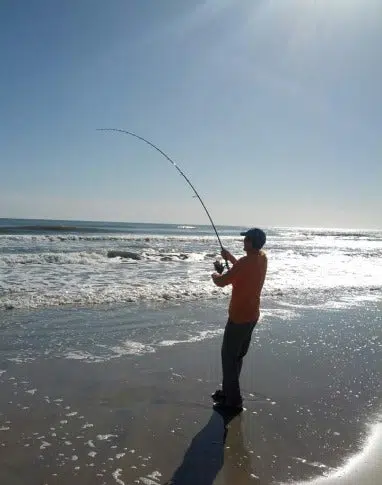
He describes it as a sliding system that lets the sinker snug down near the bait during the cast.
“When you’re casting that sinker slides right down against the bait,” Tommy said, “and it just forms a nice little compact payload.”
Weight is typically heavy. “Eight ounces and a chunk of bait is the typical,” he said.
Surf Casting Rod Length: Why 13 Feet Became the Standard
The length of surf casting rods is not about ego, it is about leverage and line control in current.
“When I started fishing Cape Hatteras, the standard was about 12 feet,” Tommy said. “Now the standard is 13 feet.”
Longer surf casting rods help you in two ways. “It gives you a longer lever to cast,” he said. It also helps you manage line and drift in the famous Cape Point “conga line,” where baits walk down current together.
If you can cast beyond the crowd, you can sometimes fish slightly lighter weight without creating chaos. “If you can cast out past everybody… you can actually get by with throwing a seven ounce instead of an eight,” Tommy said, “then you can drift faster than everybody, but you’re out past everybody.”
The Handle Setup That Most Surf Rods Get Wrong
This is where many surf casting rods fail, especially weight-and-bait heavers. The handle is not a decoration. It is a lever, and lever length is everything.
“With a short butt rod for throwing heavy weights, it just doesn’t work,” Tommy said.
His rule of thumb is practical and easy to test before you ever glue a grip.
“If you take the butt of a rod… you put it in the center of your sternum… and you stretch your hand straight out,” he said, “that’s where the center your reel seat is.”
He goes even harder for anglers ordering custom surf casting rods. “If any of you guys are having a custom rod built to throw eight and bait, and the builder does not ask you about your handle length, then you need change builders,” Tommy said.
For his own 13-foot eight-to-twelve ounce heavy heaver, Tommy’s handle length is long. “My eight to 12… is going to be 32, 32 and a half inches,” he said. As the payload gets lighter, the handle shortens because the cast becomes more about speed than leverage.
Guide Trains for Surf Casting Rods
Guide layout is not just a static-deflection exercise for surf casting rods. It changes how the blank behaves under load, especially with a multiplier.
Tommy learned this in competition where guides were taped on and moved in real time.
“If you move the bottom guide… two inches down closer to the reel, you’ve changed the power of that rod,” he said. “You’ve made it much more powerful.”
The opposite is true too. “The further up it is, the less you’re tapping into the butt power,” he said.
He also explains how guide count can change usability. “You can take a rod that’s difficult to load… remove a guide and maybe slide that bottom guide up,” Tommy said, “and you can soften that rod up and make it much more user friendly.”
For his surf casting rods, he uses Fuji KWAG guides. “I use Fuji KWAGs,” Tommy said.
On his big heaver setup, his sizes step down like this: “25 down to 20, 16, and then 12, 12, 12,” he said, with a tip in the same neighborhood. His placement reference for the first guide is tied to the ferrule and the blank’s power: “About six or seven inches down from the joint is where that first guide goes.”
The Hatteras Cast and the Five Fundamentals of Power Casting
Most surf anglers at Cape Point are not throwing full pendulum tournament casts. They are throwing what locals call the Hatteras cast.
“They actually call it a Hatteras cast,” Tommy said. “You just toss it back, turn and hit.”
Whether you fish the Outer Banks or a calmer coastline, Tommy’s coaching framework is gold because it diagnoses the real reasons people plateau.
-
Footwork
“Your footwork is very, very important,” he said. “Both feet should stay planted firmly on the ground.” Running into the cast looks powerful, but it breaks timing and shortens the left-hand pull. -
Body as the engine
“Your body is the engine,” Tommy said. “Your body is what provides the power through the first 90% of the cast.” -
Arms used at the right time
“Your arms are basically passive through the first 90%,” he said, then they punch and pull late. -
Acceleration, not violence
“One of the single biggest flaws… they get it in their head they gotta hit it hard,” Tommy said. The fix is timing. “Start slow, accelerate, finish hard and fast.” -
45 degrees shows up everywhere
He ties 45 degrees to stance, casting plane, and launch angle. “Your target is a spot 45 degrees in the sky,” Tommy said. “You want the rod to stick to 45 degrees when you finish the cast.”
A Simple Beach PSA That Saves Rods
Surf fishing eats gear, but a lot of losses are preventable. Tommy has heard the same story from customers for years.
“Never, ever, ever walk away from that rod without doing two things,” he said. “Loosening the drag and turning the clicker on.”
He has also heard the follow-up question. “Is that covered under warranty?” Tommy said. “Oh no… I don’t cover that.”
Where to Find Tommy Farmer’s Surf Casting Gear
Tommy’s systems and components are available through Carolina Cast Pro, including surf casting rods, blanks, Akios reels, and surf hardware designed for real-world abuse.
If you want to build or buy a surf casting rod that is meant for distance, not just for looks, start with the fundamentals Tommy laid out: handle length matched to the angler, a guide train tuned for the blank’s true power, a controlled multiplier setup, and a compact rig that flies clean.
Or as Tommy put it after decades of chasing distance the hard way: “You have to put in the work.”